
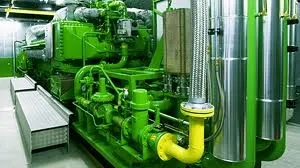
Why cogeneration
A cogeneration system is more efficient, costs less to run, keeps your power on, and works for you every day.
Lower operating costs
Generate your own power at an average of 3 to 5 cents per kWh, compared with typical utility rates of 9 to 14 cents. That can mean savings of 40% to 60% of your current operating cost.
Control inflation. Natural gas prices are projected to rise 3% a year or less, because of the large US supply.
Reasonable payback. A cash purchase typically pays back in 3 to 6 years, depending on system size.
Qualify for incentives. Cogeneration can qualify for rebates, a federal tax credit and accelerated depreciation. See project financing.
More efficient
Typical facilities get power from two sources: natural gas, burned to make hot water, and electricity from the utility. Cogeneration makes hot water slightly less efficiently than a boiler, but produces an equal amount of energy as electricity at the same time.
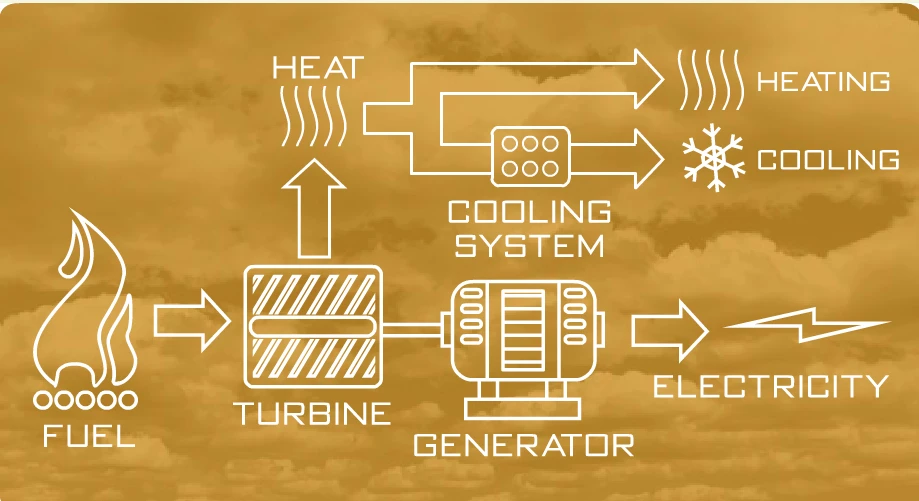
- Conventional: two fuel sources, both delivered at about 50% efficiency
- Cogeneration: one fuel source, delivered at up to 90% efficiency
- Operating cost reduced by about 45%
Up to 30% less energy purchased
Because cogeneration is more efficient, you buy up to 30% less energy, electricity and natural gas combined. For every kWh it delivers, the captured waste heat also reduces the gas your boilers burn.
Increased energy security
On-site power. Generate your own power and use utility power only when you need it, so a utility failure does not shut you down.
Reliability. Microturbines have only one moving part and can be installed as redundant modules, for example five 200 kW modules for a 1 MW system.
Improved power quality
ESD’s SeamlessPowr™ control technology lets a facility move between utility, cogeneration and diesel power without noticing the change. That matters for mission-critical operations and for sites at the end of distribution lines.
Improved life safety
With most designs, an outage means a 15 to 30 second delay before diesel backup covers the load. ESD adds an uninterruptible power supply that eliminates the gap, protecting equipment and people.
An active asset, not a passive cost
Most facilities keep diesel generators on standby. They cost money to maintain and do nothing for performance or efficiency. Cogeneration runs every day, improving power quality and reliability while lowering utility costs.
Lower emissions and a smaller carbon footprint
Electricity and natural gas both carry a carbon value. By meeting two energy needs from one fuel source, cogeneration reduces your carbon footprint. Reductions of around 10% at a facility are common, while saving money at the same time.
Waste heat can supply space heating, hot water, steam or cooling, and CARB-certified microturbines help reduce emissions further.
Turnkey installation
ESD coordinates every aspect of design and installation, working with your management and engineering teams. We bring the manufacturer into design, construction and commissioning so the project is warranty-approved and the factory protection plan is in force from day one. Third-party verification of installation and commissioning is often included.
Full service operation
- Design: all engineering, coordinated with your existing engineers
- Finance: loans, zero out-of-pocket leasing, and power purchase agreements
- Build: one turnkey contract
- Service: factory protection plans and ongoing service, from minimal to bumper-to-bumper
Find out what your facility could save
Start with a complimentary analysis of your energy use. There is no cost and no obligation.