
Frequently asked questions
Straight answers about cogeneration, natural gas and solar. Do not see your question? Call us at (916) 772-4936.
Why ESD and why cogeneration
Why ESD?
Expertise. ESD has a demonstrated track record of success in the design and installation of COGEN and SOLAR systems that provide optimal interconnection designs, maximum savings and minimum capital investment payback times.
Complimentary Analysis. ESD will perform a complimentary analysis that will:
- Analyze your daily energy use in 15 minute cycles for the entire year.
- Determine your ideal heat load/electrical consumption balance.
- Design a system that will generate maximum efficiency and cost savings.
- Recommend a system with optimal capital investment and payback time.
One Turnkey Solution. ESD can provide beginning to end services from the initial analysis to final commissioning of the system.
Why COGEN?
COGEN can help you:
- On Site Power. Avoid utility power failures by generating your own On-Site power, using utility power when you need it, and avoid utility power failures.
- Lower Costs. Generate your own power at an average of 3 to 5 cents per KWH versus your current average utility rate of 9 to 14 cents per KWH. This can result in a cost savings of 40% to 60% of your current operating cost.
- Control Inflation. Control inflation since Natural Gas prices are projected to inflate at 3.0% or less through 2035. This is due to the abundant US supply of Natural Gas energy which is twice that of the entire Saudi Arabia oil supply,
- Qualify for Incentives. COGEN will qualify for a rebate of 60 cents per watt for California made components (e.g. A 1 megawatt system qualifies for $600,000), and depreciation against the cash purchase price – a federal tax credit (10%) the first year, depreciation credit (42%) over 6 years, and state credit (7%) over 15 years.
- Increase Efficiency. Increase System Efficiency from 50% to 80% through the use of co-generation engine waste heat to assist with heating of space, hot water, steam or cooling.
- Reduce Emissions. Reduce your footprint
- Increase Sustainability. Increase System Sustainability with 10 year maintenance free warranties.
- Reasonable Payback. Provide A Reasonable Cash investment Payback of 3 to 6 years (depending on system size).
Who Uses COGEN?
Cogeneration
What is Co-generation (COGEN)?
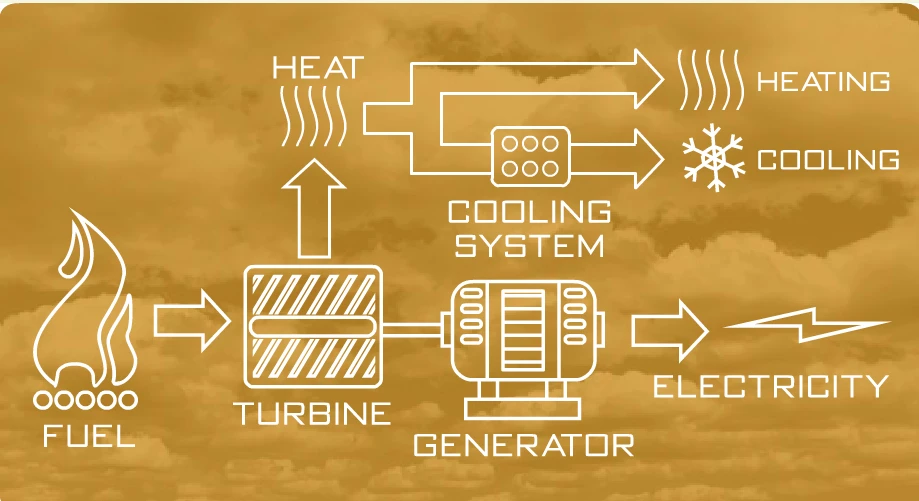
COGEN is a process where you can generate two forms of energy, electricity and heat, from a single fuel source. The basic idea is to burn Natural Gas to drive a co-generation engine (a small jet engine) which provides the torque to spin a generator which produces the electricity. Co-generation occurs when you capture and reuse the engine’s exhaust waste heat (exiting at 535o F) to assist with space heating for buildings, hot water heating, pool and spa heating, absorption cooling, steam production and centralized heating/cooling.
Figure 1.
What is a Heat Exchanger?
A heat exchanger is a specialized device that assists in the transfer of heat from one fluid to the other. In some cases, a solid wall may separate the fluids and prevent them from mixing. In the most efficient heat exchangers, the surface area of the wall between the fluids is maximized while simultaneously minimizing the fluid flow resistance. Fins or corrugations are sometimes used with the wall in order to increase the surface area and to induce . Perhaps the most commonly known heat exchanger is a car radiator, which cools the hot by taking advantage of airflow over the surface of the radiator.In the case of co-generation engines, the energy from exhaust waste heat is transferred to assist with space heating, hot water heating, steam production, chemical processing, and cooling with absorption chillers.
What is an Absorption Chiller?
The waste heat vaporizes a chemical in a vacuum into a gaseous state. The gas cools when it expands into the gaseous state and is then routed through a heat exchanger as a refrigerant. The refrigerant then cools the fluid that is used in a cooling cycle.
The two most common refrigerant/ absorbent mixtures used in absorption chillers are water/lithium bromide and ammonia/water.
Compared with mechanical chillers, absorption chillers have a low coefficient of performance (COP = chiller load/heat input). However, absorption chillers can substantially reduce operating costs because they are powered by low-grade waste heat. Vapor compression chillers, by contrast, must be motor- or engine-driven.
Absorption Chiller/Refrigeration – An absorption chiller is a transfer heat device which uses the co-generation engine waste heat to drive the cooling process.
Can COGEN help me generate my own power?
A Natural Gas fired Co-generation system will enable you to generate your own on-site power and operate off the utility power grid. It allows you to operate as a stand-alone system, and use utility power only when it is needed.
COGEN can self-start without outside power and load follow your power demand needs as they fluctuate during the day. If your demand exceeds the COGEN system capacity, it will switch in the parallel use of utility power (seamlessly) to meet the excess demand.
Can I avoid utility power failures by operating off the utility power grid?
COGEN improves power reliability by reducing or eliminating a building’s dependence on the electric power grid, and makes power outages improbable.
During major grid failures, COGEN can continue to operate up to its maximum design capacity. For example, over 30 hospitals with COGEN continued routine operations during the August 2003 California power blackout.
Where the grid is at or near capacity, COGEN will reduce the grid’s load, thus increasing grid reliability and homeland security.
Will COGEN generate power at a lower cost than the utility rates?
The gas price vs. electric rate is known as the “Sparks Spread”. The cost of Natural Gas has dropped dramatically (by 66%) in the past 4 years. This has made the use of Natural Gas co-generation systems to generate electricity very cost competitive.
The use of low cost Natural Gas allows COGEN to generate power at a cost that is 40% to 60% lower than the standard utility rates per KWH. (e.g. The COGEN rate could be less than 5 cents per KWH vs. today’s current Utility rates which can range from 10 cents to 20 cents per KWH. This represents a minimum savings of 50% if your utility rate is 10 cents per KWH, and more if your utility rate is higher.
What Kind of Savings Will COGEN Generate?
Savings Are Substantial. Assuming a minimum threshold of energy consumption and energy costs that justifies the capital expenditure, COGEN can generate savings from 50% to 60% of current operating costs. A recent typical client example is as follows:
- Total Annual KWH used = 1,213,819 KWH
- Total Annual Electricity Cost = $173,906
- Proposed System Size is 130 KW
- COGEN 1st Year Savings = $104,175 (cash purchase)
- Total 15 Year COGEN Savings = $2,225,026 (cash purchase)
Will COGEN qualify for any financial incentives?
COGEN will qualify for the following financial incentives for a cash purchase:
- Federal tax credit – 10% of purchase price
- Rebate incentives at $.50 per watt (e.g. 100 KW = $50,000)
- Investment credit – 42% of purchase price (over 6 years)
- State credit – 7% or purchase price (over 15 years)
Will COGEN help me reduce the annual inflationary cost of generating electricity?
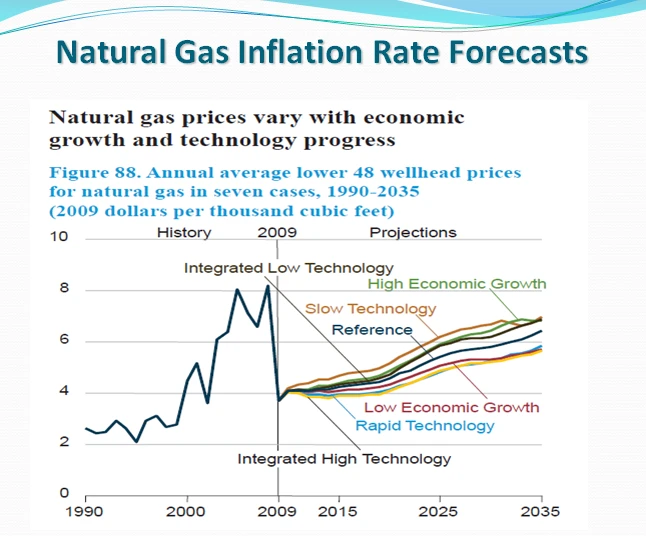
The availability of Natural Gas has increased to a level where the US NG energy supply is double that of Saudi Arabia’s entire oil supply. The NG cost is projected to inflate at a lower rate than fossil fuels through 2035. See Figure 2. This will control COGEN’s inflation rates well below the average utility annual rate increases. COGEN may average 3.0% or less, versus the actual utility annual increases of 4% to 6% over the last decade.
Figure 2
Is the COGEN system more efficient than utility power?
COGEN will increase your overall system efficiency from 50% to 80%.
Conventional power plants burn fossil fuel to produce steam which drives a turbine to create electricity. Only one-third of the fossil fuel is converted to electricity. Two-thirds goes up the smokestack as heat. The transmission and distribution losses further reduce the delivery of electricity to your business. The delivered power is then used at your plant to generate electricity at an efficiency of 50%.
COGEN is 2-3 times more efficient than conventional power plants. COGEN captures and reuses the co-generation engine thermal waste heat to assist with hot water heating, air space heating, pool and spa heating, steam and centralized heating/cooling. This increases the in-plant system efficiency from 50% to 80%. The on-site delivery of energy also avoids transmission and distribution losses.
What payback can I expect on a COGEN investment?
A cash purchase payback can range from 2 to 6 years depending on your current utility rate per KWH, total KWH used and use of the co-generation waste heat. Here are some examples:
[table caption=”” width=”500″ colwidth=”20|100|50″ colalign=”center”]
Case,KWH Rate,KWH Used,Heat Used,System Cost, Payback Years
1,$.1254,4M,100%,$11.2M,4.7
2,$.1481,2M,88%,$2.0M,5.1
3,$.1363,2M,100%,$.95M,3.1
4,$.1228,6M,100%,$14.5M,2.4
[/table]
Is there flexibility in how you can operate the COGEN Units?
A unique feature of COGEN is the ability to stack the units. If your power needs are 200KW to 1MW, it is possible to stack one to five of the 200KW units to meet your needs.
In addition, the stack ability allows you to run only as many units as are needed at any time. For example, if you need only 600 KW of the 1 MW, you can operate all units at 60% capacity, or just 3 at full capacity and leave the other 2 units idle.
Will COGEN reduce my carbon footprint?
The co-generation systems are CARB certified and will reduce your carbon emissions. COGEN will significantly reduce pollutant emissions such as Nitrogen Oxide, Sulphur Dioxide and Carbon Dioxide. It reduces emissions by 45% when compared to conventional centralized power plants. It will also reduce CO2 emissions at half the cost of Solar
COGEN will also lower the consumption of fuel, thus reducing carbon emissions while increasing energy efficiency.
Will COGEN help me with comply with AB32?
AB32 will impose carbon emissions penalties on the generation of electricity (beginning in 2013) and heat (beginning in 2015). Because the micro-turbines are CARB certified it will reduce the CO2 impact for both penalties.
How maintainable is the COGEN equipment?
10 Year Maintenance Warranty. Because of the co-generation engine’s high reliability, COGEN suppliers will typically offer a 10 year maintenance free bumper to bumper warranty as part of the purchase price.
This includes all scheduled and unscheduled maintenance, parts and labor at a single rate based on system run hours. There are no hidden costs.
A cyber-link connection allows for the immediate remote monitoring and troubleshooting of problems. Site visits are provided on same day/next day service, and an on call basis for weekend emergency service.
How much space is needed to install the COGEN equipment?
A single 200KW module is about 6 foot tall, 3 foot wide, 3 foot deep (about the size of a large double refrigerator) and can be installed within a footprint of one car parking space.
How noisy is the COGEN equipment?
COGEN is Quiet. The co-generation noise level is equal to that of a noisy dishwasher. It can also be housed in a sound-attenuated enclosure to meet local city permit db level requirements.
Natural gas
Why use Natural Gas for power generation?
Commonly Used. Natural Gas is used as a source of energy to heat water, heat building air space, generate steam, and power internal combustion engines to generate both electricity, cooling or thermal heat for manufacturing plant operations.
Low Emissions. Natural gas is a clean fuel. The main products released when it is burned are carbon dioxide and water vapor. Coal and oil are more chemically complex and, when burned, will release a variety of potentially harmful chemicals into the air.
Inflationary Cost. Natural Gas prices have declined by 66% in the last few years and is projected to inflate at less than 3.0% per year through 2035. This is lower than the utility inflation rates of 5 to 6% over the past decade. Utility rates will inflate at a higher rate than NG costs.
NG Supply. The low projection of inflationary costs is due to the abundant US supply of NG energy which is currently twice that of the entire Saudi Arabia oil supply.
KWH Generation Costs. Because of its low cost, Natural Gas fired co-generation systems can generate electric energy at a lower cost that is 40% to 60% lower than current utility rates (e.g. 3 to 5 cents per KWH versus the current average utility rates of 9 to 14 cents per KWH),
Who provides the Natural Gas normally?
The natural gas is normally provided by your local utility company. As an example, 50% of the residential households receive natural gas from the utility or 3rd party providers, and use approximately 21% of the nation’s consumption of natural gas.
Can I buy my NG from ESD?
ESD is a certified and authorized supplier for Natural Gas Services in your state and can deliver Natural Gas to meet your energy needs. ESD has established a partnership with a preferred Natural Gas supplier that:
Is the 2nd largest provider of low cost Natural Gas in California.
Currently serves 25,000 clients in Northern California.
Reliably delivers over 20,000,000 MMBTU of NG Services every month.
Consistently delivers Natural Gas at a savings over utility rates.
Reflects our “customer first” philosophy of integrity, quality and service.
How will I get my natural gas from ESD?
ESD’s natural gas supplier will deliver the NG through the existing utility company’s gas supply lines, and will bill you for the commodity (gas).
Your utility will charge you for the normal transportation charges, but is not allowed to mark up the cost of the Natural Gas delivered by ESD.
Why should I buy my gas through ESD?
ESD can deliver the same amount of Natural Gas you currently use at a savings.
Our supplier has consistently delivered Natural Gas at a lower price than PGE (32 out of 42 months = 76%).
Our success is based on a “customer first” philosophy of providing integrity, quality and concern for each and every customer.
Who do I call if I have any problems or questions?
Your primary relationship remains with ESD. Your ESD account executive will respond to all calls, answer all of your energy service questions and resolve any issues or problems you may encounter.
Will the quality of gas I receive be the same?
Yes. Natural gas must meet certain standards before it is allowed to enter the transportation pipelines. Once gas is introduced into the pipelines, it is co-mingled with the gas already present so that the quality of the gas you receive on behalf of the utility companies or ESD is indistinguishable.
Who will take care of my gas system?
Your utility company will continue to deliver the energy to your home or business. The utility handles meter reading and repair, gas transportation, line repair and emergency calls. You will never be asked to allow a stranger access to your premises whom you cannot identify as an employee of your utility.
Can ESD shut off my gas?
No. The control of your gas service remains with your utility company. If you lose your supplier for any reason, you will be given 15 days notice to allow you time to choose a new supplier, or by default you will return to the local utility.
Can I decide later to return to the utility?
Yes. If for any reason you decide that you prefer having your gas supplied by the utility, you can switch back, subject to the terms of your contract with your current gas supplier.
Can I be switched from ESD to another supplier without my approval?
No. To minimize the potential for unauthorized switching (a process known as “slamming”), ESD is required to agree to state rules and guidelines for obtaining, maintaining and stopping service. These provisions, copies of which are filed with the state, include a ban against unauthorized switching. Suppliers that slam must pay all costs and fees incurred by the customer and the utility arising from such a switch, as well as any costs to switch the customer back. The state may also impose additional penalties.
Will the utility be upset if I switch to an ESD?
No. Most utilities have programs in place introducing customers to deregulation and promoting the idea of choice in their energy suppliers. They understand that a competitive marketplace should bring about enhanced services and price benefits.
If I use ESD, will I receive two bills?
ESD will work with your utility company to offer you a single bill that covers all monthly consumer charges. There are occasions where two bills may be appropriate for some customers.
What’s in natural gas?
Natural gas found in the ground contains methane, ethane, propane,butane, pentane, and traces of hexane and heptanes. Gas utilities remove almost everything but the methane so the natural gas delivered to your home will burn cleanly.
What is methane?

What makes natural gas a clean fuel?
The main products released when natural gas is burned are carbon dioxide and water vapor. Coal and oil are more chemically complex than natural gas, so when burned they release a variety of potentially harmful chemicals into the air.
What is Natural Gas used for?
The heat from the burning of Natural Gas is commonly used to heat water, heat building air space, generate steam, power internal combustion engines or turbines to generate both electricity, cooling or thermal heat for manufacturing plant operations.
Why is natural gas used to run electric power plants?
In the 1970s and 1980s, most electric power plants were fueled by coal or nuclear power. But due to environmental concerns, by the 1990s, about 60 percent of new electric power plant capacity was fueled by natural gas. Today natural gas is the primary energy source for powering new electricity generating plants in the U.S because it is a clean-burning and competitively priced fuel. (Source: American Gas Association)
Is it cheaper to use Natural Gas to generate electricity or thermal heat?
Yes. Natural Gas prices have dropped dramatically by 66% over the past few years from $12 per MMBTU to less than $3.50 per MMBTU in 2012. This drop in cost makes it very competitive for a company to use alternate energy systems, like Natural Gas Fired Co-generation, to generate electricity at a cost under $.05 per KWH versus the utility averages of $.10 to $.20 per KWH, providing a substantial savings of 30% and more.
How large is the US supply of Natural Gas?
The US Natural Gas energy supply is estimated to be twice that of the entire Saudi Arabia oil supply. The combined Energy Information Administration (EIA) and Potential Gas Committee estimates indicate there is a total available future supply of 2,170 Trillion cubic feet, which would equal about 100 years of supply. Americans consume an average of 22 Tcf of natural gas per year.
What is the forecast for Natural Gas price increases?
Natural Gas inflationary costs are forecasted to rise at an average rate of less than 3.0% per year for the next 20 years.
How much of our country’s energy needs are served by natural gas?
Natural gas supplies about 24 percent of all energy used in the United States.
Where in the United States is natural gas located?
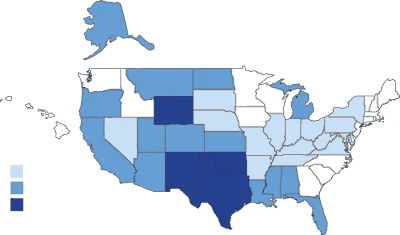
Natural gas is found in 33 states. The dark blue states on this map show you where large amounts of natural gas are extracted. In the medium blue states, moderate amounts of natural gas are extracted. And in the light blue states, just a little natural gas is extracted. Natural gas is not extracted at all in the white states.
How much natural gas is produced in the world?
Natural gas is found in about 50 countries. About 2,600 billion cubic meters of natural gas was taken out of the ground and processed for use in 2003. Here is a breakdown of how much of that was produced by various countries and regions:
- United States 21.0%
- Canada 7.0%
- Mexico 1.4%
- Central and South America 4.5%
- Europe and Eurasia 17.0%
- Russian Federation 22.1%
- Middle East 9.8%
- Africa 5.4%
- Asian and Pacific Countries 11.9%
(Source: BP Statistical Review of World Energy 2004)
How much natural gas do we use?
About 2,600 billion cubic meters of natural gas was used in the world in 2003. Here is a breakdown of how much of that was used by various countries and regions:
- United States 24.3%
- Canada 3.4%
- Mexico 1.8%
- Central and South America 4.2%
- Europe and Eurasia 26.1%
- Russian Federation 15.7%
- Middle East 8.6%
- Africa 2.6%
- Asian and Pacific Countries 13.3%
(Source: BP Statistical Review of World Energy 2004)
Why does natural gas smell like rotten eggs?
In its natural state, natural gas has no odor. Utility companies add a chemical odorant called “mercaptan” to natural gas to help make gas leaks easier to notice. If you have a natural gas stove, you may have smelled this rotten egg odor when the pilot light has gone out.
What is “liquefied natural gas?”
When natural gas is cooled to 260 degrees below zero, it changes from a gas into a liquid. Liquid natural gas takes up much less space than natural gas, making it easy to transport and convenient to store. Six hundred cubic feet of natural gas turns into just one cubic foot of liquid gas!
What is a “smart pig?”
A smart pig is an electronic device that can be used to inspect the insides of natural gas pipelines. The device travels through a pipeline and transmits images of the inside of the pipeline so inspectors can tell if the pipeline needs repairs.
How fast does natural gas move through pipelines?
Natural gas travels through pipelines at the slow and steady pace of 15 miles per hour.
Solar
How does a Solar System work?
Solar energy takes advantage of the sun’s rays to generate heat or electricity. It is an infinitely renewable resource and unique for its ability to generate energy in a quiet, clean, and consistent manner. A photovoltaic cell, or “solar cell,” is the smallest semiconductor element that converts sunlight into electricity. Each cell is made of silicon or another semi-conductor material, like a computer chip. The silicon is treated so that it generates a flow of electricity when light shines on it.
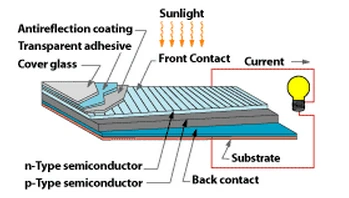
What are the components of a Solar System?
You will need a photovoltaic panel to capture the sun’s energy, a roof mount to support the PV panel, an inverter to convert the direct current (DC) produced from the photovoltaic cells into alternating current (AC) used by your home, and a house utility meter – called a net meter – that can record both the electricity produced from your home’s power system as well as any power you may use off the grid. These system components are then connected through a combiner box with series of wiring. The photovoltaic panels are secured to your roof with panel mounts or are installed on poles that can be adjusted for sun angle.
PhotoVoltaic (PV) Panel – Generates electricity from the suns rays.
Roof Mounting – Secures the PV panels to the roof.
inverter – Converts the PV DC into AC voltage for building use.
Combiner Box – Junction box to connect wiring between the PV cells, Inverter, Meter and Building.
Net Meter – Measures energy input from PV cells and measures energy being used or being returned to the power grid.
How much space do I need to install a solar system?
In bright sunlight, a square foot of a conventional photovoltaic panel will yield 10 watts of power. That’s a helpful rule of thumb for calculating a rough estimate of how much area you might need. For example, a 1000 watt system may need 100 – 200 square feet of area, depending on the type of PV module used. A 1,000,000 (megawatt) system may require 100,000 to 200,000 square feet.
Will I need a building permit to install a solar energy system?
Yes. You’ll need to obtain building permits to install a solar photovoltaic or solar hot water system. Similarly, building, electrical, and plumbing codes also apply. Solar power systems do not use “radical” building techniques and most jurisdictions have building codes that fully embrace solar energy technology.
How long will it take to install a solar system?
Planning, configuring, and doing any custom ordering for your solar energy system can take up to a few weeks.
The installation of a small residential system can typically be completed in a few days time. Larger commercial installations that require the engineering design and construction of extensive roof or ground support systems may take several weeks.
Can I use solar to heat my pool?
Yes. Pool heating systems can use a modified solar hot water system to capture the sun’s rays and heat your pool or hot tub.
Can I use solar to heat my home?
Yes. Solar can heat your home by using the solar energy to heat water, which is then transferred through pipes into an under floor radiant heating system. Radiant floor systems are typically 40 percent more efficient than their forced air counterpart and can be zoned to match thermal comfort to each room.
What maintenance does the solar system need?
The solar photovoltaic panels require little maintenance. No need to wash or dust. It is, however, important to place panels where they will remain clear of shade and debris. Thus you will have to wipe them off if too much snow or leaves fall on them.
Solar hot water collection arrays do not require much attention either. It does help to periodically use a window wash brush, biodegradable soap, and water to clean the tubes.
What is the difference between Solar PhotoVoltaic and Hot Water Systems?
While both types of solar systems capture energy from the sun, solar photovoltaic systems use photovoltaic panels to produce electricity. Solar hot water, or thermal, systems capture sunlight to heat water for domestic use, to heat a swimming pool, or for a radiant heating system.
What is the cost of a Solar System?
Solar Panels – As of 2015, solar panels cost approximately 80¢ per watt, which which is a sharp reduction from $3 per watt just three years ago. In addition, the solar panels themselves have improved from about 12% efficiency to over 18% efficiency. Therefore, the panels for a 5,000 watt system could cost $15,000 for a typical residence of 2,000 square feet. The addition of associated equipment such as panel mounts, inverters, and metering could cost approximately $1,000. Larger commercial installations would be sized according to KWH consumption and the available rooftop or ground level space for the installation of solar panels.
Federal Incentive Credits – Federal Tax Credits for solar systems signed into law on February 17th, 2009. This law provides a 30% nonrefundable energy tax credit for the cost of a qualified system through 2016. This includes solar electric (PV) systems, solar hot water heaters, geothermal heat pumps and wind turbines. When combined with state-level credits, it can dramatically reduce the cost of a solar PV system, sometimes by as much as 40-50%.
How much will I save with a Solar System?
Your savings will depend on the size of system you are installing vs. your average monthly use of kilowatt hours (KWH). It can be calculated in 6 steps:
Step 1: Calculate your average monthly cost for electricity.
Step 2: Calculate your average monthly use of KWH from your bills (Let’s assume it is 600 KWH)
Step 3: Calculate the maximum KWH generated by the solar system you have installed (assume your 4 kilowatt system generates electricity for 4.3 hours per day for 30 days). Maximum = 516 KWH
Step 4: Reduce the maximum generated KWH by 20% to arrive at a realistic contitions for rain and cloudy weather. Realistic = 412 KWH.
Step 5: Divide the realistic 412 kWH by the average of 600 KWH = 69%
Step 6: Multiply your average monthly bill by 69% to arrive at your savings. If you were paying $200 per month, you would save $138 per month, or $1,656 per year.
What kind of financing is available for Solar?
In addition to a cash purchase, you may consider:
Home equity financing – A home equity loan can be used for the purchase and installation costs of a solar photovoltaic or solar hot water system to take full advantage of federal tax deductions. Solar energy systems are also viewed as a major home energy savings upgrade and is comparable to other upgrades such as installing a new deck or remodeling a kitchen.
Lease purchase – Some vendors offer lease purchase financing with a large buyout discount after they have realized their tax benefit writeoffs.
Purchase Power Agreement – Some vendors will allow you to purchase the power directly from them through a purchase power agreement. The rates will be similar to the utility rates, but do offer a large buyout discount after the vendor has realized their tax benefit writeoffs.
What is the payback on a Solar investment?
You can calculate the payback in 4 steps:
Step 1: Determine initial annual savings from PV system. Let’s use the $1.656 per year from question 12.
Step 2: Assume a conservative electricity inflation rate of 4% increase per year for the next 25 years.
Step 3: Multiply the $1,656 annual savings by the energy inflation rate of 1.04 for each year over the next 25 years (the solar panels are warranted for 25 years). Cumulative savings is:
Year 5 = $8,968
Year 10 = $19,969
Year 15 = $33,244
Year 20 = $49,395
Year 25 = $69,106
Step 4: Subtract the initial cost from the accumulated savings – To see how you are paying off your initial investment
When should I not put in a solar system?
Poor Insulation – If your home is under insulated, there is no point in creating energy using solar panels only to have that very same energy go out through your roof and be wasted.
Old Roof – If your roof is on its last legs you probably should consider getting the roof done first so there is a good foundation for the solar panels.
Unavoidable Shade – Solar panels are very durable devices but their performance drops significantly if all or even part of the panel is exposed to direct shade for any length of time. If the shade cannot be removed effectively it will not be cost effective to install the solar.
Payback is Too Long – The payback period for solar energy may be too long. This is particularly true in those states that do not provide any incentives for solar energy. Any payback analysis should include an adjustment for the annual rise in energy costs. Some estimates used are 6% per year. Solar panels will last 25-30 years at minimum.
Find out what your facility could save
Start with a complimentary analysis of your energy use. There is no cost and no obligation.